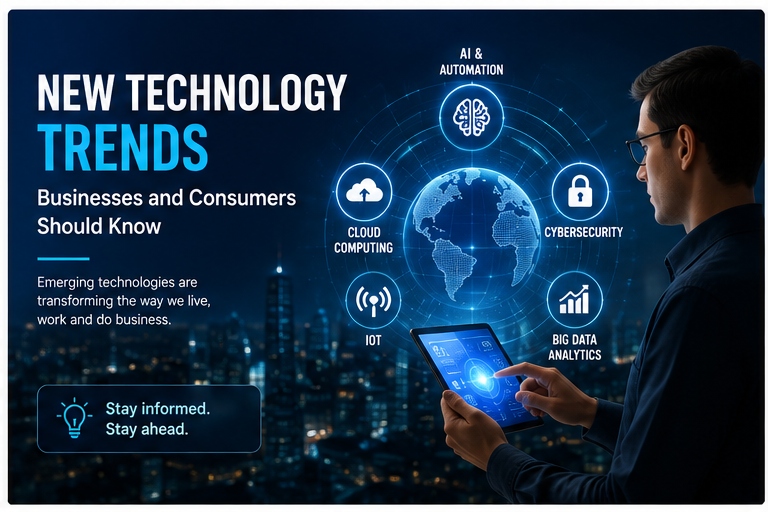
Technology is changing faster than ever, influencing how businesses operate and how consumers communicate, shop, work, learn, and manage everyday life. Artificial intelligence is becoming part of common software, cloud platforms are changing business infrastructure, connected devices are becoming smarter, and cybersecurity is receiving greater attention as digital activity expands.
Understanding new technology trends is no longer important only for technology professionals. Business owners need to know which innovations could improve productivity and customer experiences, while consumers need to understand how emerging technologies may affect convenience, privacy, security, and daily life.
This article explores some of the most important technology trends businesses and consumers should know and explains how they may shape the digital future.
Why New Technology Trends Matter
Technology can quickly change customer expectations and competitive markets.
A business that once depended entirely on physical stores may now need e-commerce, digital payments, social media, and automated customer support. Employees increasingly use cloud-based collaboration tools, while consumers expect services to be available across smartphones and other connected devices.
Keeping up with technology trends can help businesses identify opportunities before competitors and prepare for potential risks.
For consumers, understanding technological change can make it easier to choose useful products, protect personal information, and make informed decisions about new digital services.
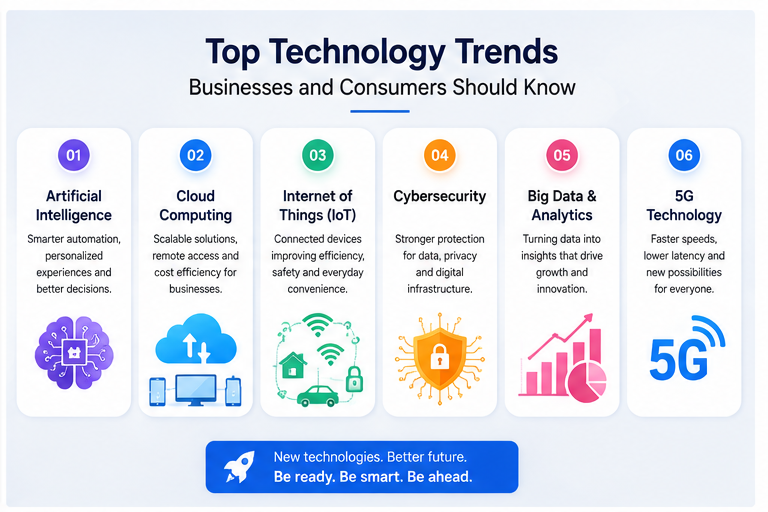
1. Artificial Intelligence Is Becoming Mainstream
Artificial intelligence is one of the most influential technology trends.
AI systems can analyze information, recognize patterns, generate content, automate repetitive processes, and assist people with complex tasks.
Businesses are increasingly exploring AI for areas such as:
- Customer support
- Marketing
- Data analysis
- Fraud detection
- Content creation
- Software development
- Sales forecasting
- Business automation
Consumers also encounter AI through search tools, recommendation systems, virtual assistants, photo applications, navigation services, and smart devices.
Generative AI Is Expanding
Generative AI has attracted particular attention because it can produce text, images, software code, audio, and other types of content.
Businesses can use these tools to assist employees with brainstorming, summarizing information, preparing drafts, analyzing data, and handling routine work.
However, organizations should not rely on AI output without appropriate human review. Accuracy, privacy, intellectual property, security, and responsible use remain important considerations.
2. AI Agents and Intelligent Automation
Traditional automation usually follows predefined rules. More advanced AI-based systems are increasingly capable of handling multi-step tasks with greater flexibility.
AI agents may be designed to gather information, use software tools, analyze results, and complete parts of a workflow.
For businesses, this could influence areas such as customer service, administrative operations, IT support, sales, and internal knowledge management.
Consumers may also see increasingly capable digital assistants that can help organize information and perform routine digital tasks.
The major opportunity is productivity, but organizations need clear permissions, monitoring, and security controls when automated systems can take actions.
3. Cloud Computing Continues to Transform Business
Cloud computing has already changed how organizations store data and operate applications, but its importance continues to grow.
Instead of purchasing and maintaining all computing infrastructure internally, businesses can use cloud services according to their needs.
This can provide benefits such as:
Scalability
Businesses can increase or reduce computing resources as demand changes.
Remote Accessibility
Authorized employees can access applications and information from different locations.
Faster Deployment
Companies can often introduce digital services without building every component of their infrastructure from the beginning.
Business Continuity
Cloud-based backup and recovery strategies can help organizations prepare for certain hardware failures and disruptions.
Consumers interact with cloud computing every day through email, online storage, streaming platforms, photo backups, and collaborative applications.
4. Cybersecurity Is Becoming More Important
As digital technology expands, cybersecurity becomes increasingly important.
Businesses store valuable information about customers, employees, transactions, and operations. Cybercriminals may attempt to steal this information through phishing, malware, account compromise, social engineering, and other attacks.
Modern cybersecurity strategies increasingly emphasize multiple layers of protection.
Businesses should consider practices such as:
- Multi-factor authentication
- Strong access controls
- Regular software updates
- Employee security awareness
- Secure backups
- Encryption
- Network monitoring
- Incident-response planning
Consumers also need strong security habits.
Using unique passwords, enabling multi-factor authentication, keeping devices updated, and being cautious with suspicious messages can significantly reduce common risks.
5. The Internet of Things Is Expanding
The Internet of Things (IoT) refers to physical objects that contain sensors, software, and network connectivity.
Examples include smart thermostats, security cameras, fitness trackers, industrial sensors, connected vehicles, and smart appliances.
Businesses can use IoT technology to monitor equipment, track inventory, improve logistics, reduce energy consumption, and collect operational information.
Consumers benefit from convenience and automation.
For example, smart home devices can control lighting, temperature, security systems, and appliances.
However, every connected device can potentially create additional privacy and cybersecurity considerations. Manufacturers and users therefore need to take device security seriously.
6. 5G and Advanced Connectivity
Faster and more reliable mobile connectivity can support many emerging technologies.
5G networks are designed to provide improvements in areas such as capacity, speed, and latency compared with earlier mobile generations, although actual performance depends on location, network deployment, device compatibility, and other factors.
For businesses, improved connectivity can support remote operations, connected equipment, mobile applications, and IoT deployments.
Consumers can benefit from improved mobile internet experiences, including video streaming, online gaming, communication, and cloud-based services.
As network infrastructure continues developing, connectivity will remain an important foundation for digital innovation.
7. Edge Computing
Cloud computing usually involves sending information to remote computing infrastructure for processing.
Edge computing takes a different approach by processing certain information closer to where it is generated.
This can be useful when fast responses are required or when sending every piece of information to a distant cloud system would be inefficient.
Potential applications include:
- Industrial equipment
- Smart factories
- Connected vehicles
- Security systems
- Healthcare technology
- Retail environments
- IoT devices
Edge computing does not necessarily replace cloud computing. The two technologies can work together, with different workloads handled where it makes the most sense.
8. Augmented and Virtual Reality
Augmented reality (AR) adds digital elements to a user’s view of the physical world, while virtual reality (VR) creates more immersive digital environments.
These technologies are becoming useful beyond entertainment.
Businesses can explore AR and VR for employee training, product demonstrations, architecture, education, remote collaboration, and design.
Retailers can also use augmented reality to help customers visualize products before purchasing.
For example, customers might digitally preview furniture in their homes or see how certain products could look before ordering them online.
These experiences can make online shopping more interactive.
9. Spatial Computing
Spatial computing combines digital content with physical environments in ways that allow people to interact with information more naturally.
It may involve technologies such as sensors, cameras, computer vision, augmented reality, virtual reality, and advanced displays.
For businesses, potential applications include product design, employee training, engineering, healthcare, and visualization.
For consumers, spatial computing may gradually change entertainment, communication, productivity, and shopping experiences.
The technology is still developing, and cost, comfort, software availability, and practical usefulness will influence adoption.
10. Smarter Robotics
Robotics is another technology field experiencing rapid development.
Industrial robots have been used in manufacturing for decades, but improvements in sensors, computer vision, artificial intelligence, and software are expanding what robots can do.
Businesses may use robots for manufacturing, warehouse operations, inspections, agriculture, logistics, and other repetitive or physically demanding activities.
The goal is often not simply to replace human workers. Robotics can also help employees handle dangerous or repetitive tasks while people focus on work requiring judgment, creativity, and communication.
11. Blockchain Beyond Cryptocurrency
Blockchain technology is commonly associated with cryptocurrencies, but the underlying concept can have other applications.
A blockchain provides a distributed method for recording and verifying information.
Organizations have explored blockchain for areas including supply-chain tracking, digital identity, financial services, and record management.
However, blockchain is not automatically the best solution for every business problem.
Companies should evaluate whether decentralization and distributed verification provide meaningful advantages compared with traditional databases or other technologies.
12. Digital Payments Continue to Grow
The way consumers pay for goods and services continues to change.
Mobile wallets, contactless payments, online banking, QR payments, and digital financial platforms have made electronic transactions more convenient.
Businesses can benefit from faster transactions, easier online commerce, and improved payment flexibility.
Consumers appreciate the ability to make purchases without always carrying cash.
At the same time, payment security remains essential. Financial businesses need strong fraud-prevention and authentication systems, while consumers should protect accounts and avoid sharing sensitive financial information.
13. Biometric Technology
Biometric authentication uses characteristics such as fingerprints or facial features to help verify identity.
Many consumers already use biometrics to unlock smartphones or authorize certain transactions.
Businesses may use biometric systems for authentication, security, attendance, or controlled access.
The technology can improve convenience because users do not need to type passwords for every interaction.
However, biometric information is sensitive. Organizations implementing these systems should carefully consider security, privacy, storage, consent, and applicable legal requirements.
14. Sustainable and Green Technology
Technology companies and other organizations are increasingly considering energy efficiency and environmental impact.
Green technology can include renewable-energy systems, energy-efficient data centers, electric transportation, smart energy management, and technologies that help organizations measure resource consumption.
Artificial intelligence and IoT systems may also help businesses optimize energy usage.
For consumers, developments in electric vehicles, smart home energy systems, efficient appliances, and renewable power technologies can provide more choices for reducing energy consumption.
Sustainability is likely to remain an important consideration as technology infrastructure continues to expand.
15. Quantum Computing
Quantum computing is one of the most advanced areas of computing research.
Traditional computers process information using bits, while quantum computers use quantum bits, or qubits, and quantum mechanical effects to approach certain computational problems differently.
Potential future applications are being researched in areas such as materials science, optimization, scientific simulation, and cryptography.
However, consumers should understand that quantum computing is not currently a replacement for everyday laptops or smartphones.
Much of its potential remains specialized and experimental.
For businesses, the most practical strategy is often to understand developments and consider their possible long-term implications rather than expecting immediate widespread deployment.
16. Privacy-Enhancing Technologies
As businesses collect and analyze more information, privacy has become an increasingly important issue.
Consumers want useful personalized services, but many also want greater control over how their information is collected and used.
This is encouraging interest in privacy-enhancing technologies and data-management practices that can reduce unnecessary exposure of sensitive information.
Businesses should think carefully about what information they collect, why they need it, how long they retain it, and who can access it.
Strong privacy practices can support customer trust as well as regulatory compliance.
How These Technology Trends Affect Businesses
New technologies can create major opportunities, but adopting every trend is rarely a good strategy.
Businesses should first identify genuine problems.
For example, a company struggling with repetitive customer questions might evaluate AI-assisted support. A manufacturer experiencing equipment downtime might investigate IoT monitoring. A business with distributed employees might focus on secure cloud collaboration.
Technology should serve business goals rather than become the goal itself.
Before adopting new systems, organizations should evaluate costs, security, employee training, integration requirements, expected benefits, and potential risks.
How These Trends Affect Consumers
Consumers will increasingly interact with AI, connected devices, digital payments, cloud services, biometric authentication, and personalized digital platforms.
These technologies can provide significant convenience.
At the same time, consumers should develop stronger digital awareness.
Before adopting a new service, it can be helpful to consider:
- What personal information does it collect?
- Why does it need certain permissions?
- Does the provider offer security controls?
- Can multi-factor authentication be enabled?
- Is the technology genuinely useful?
- What happens to stored information if the service is discontinued?
Being informed allows consumers to enjoy technological benefits while managing potential risks.
Challenges of Rapid Technological Change
Innovation does not come without challenges.
One major concern is cybersecurity. More connected systems can create more potential points of attack.
Another challenge is privacy. AI systems, smart devices, and personalized services may process large amounts of information.
Businesses also face financial challenges when adopting technologies before understanding their actual value.
There are workforce considerations as well. Automation may change certain job responsibilities while increasing demand for new skills.
Education and professional development will therefore remain important as technology continues evolving.
How Businesses Can Prepare for Future Technology
Businesses do not need to predict every technological development correctly.
Instead, they can build the ability to adapt.
Organizations should regularly evaluate new technologies, improve cybersecurity, modernize outdated systems where appropriate, train employees, maintain reliable data practices, and experiment with promising technologies on a manageable scale.
Starting with pilot projects can be particularly useful.
Instead of deploying a new technology across an entire organization immediately, businesses can test it in a limited environment, measure results, identify problems, and then decide whether wider adoption makes sense.
The Future of Technology
The next stage of technological development will likely involve greater integration between different technologies.
Artificial intelligence may work alongside robotics. IoT devices may combine with edge computing and faster networks. Cloud platforms may provide infrastructure for increasingly advanced AI services.
Consumers may interact with technology through more natural interfaces involving voice, vision, gestures, and intelligent assistants.
Businesses may automate more routine operations while employees focus on decision-making, relationships, creativity, and strategy.
The companies that benefit most will not necessarily be those adopting new technology first. They may be the organizations that identify where technology genuinely creates value and implement it responsibly.
Final Thoughts
Understanding new technology trends is increasingly important for businesses and consumers because technology now affects almost every part of modern life.
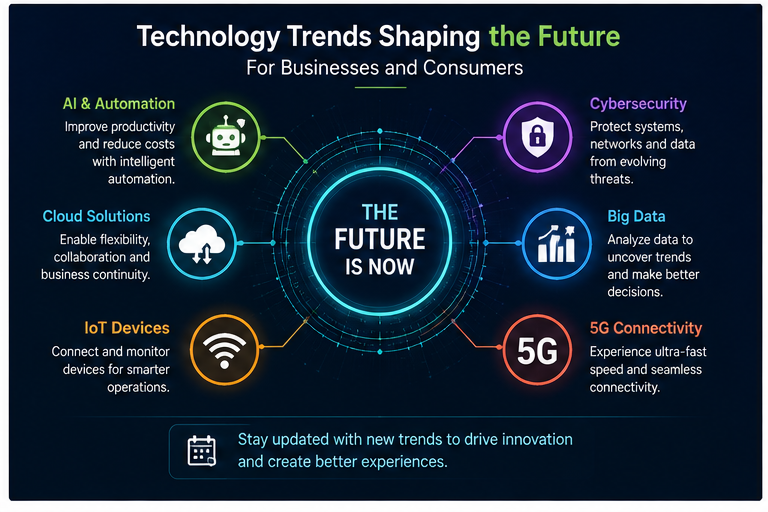
Artificial intelligence, intelligent automation, cloud computing, cybersecurity, IoT, 5G, edge computing, spatial computing, robotics, digital payments, biometrics, sustainable technology, and quantum computing are among the developments worth watching.
For businesses, these technologies can create opportunities to improve productivity, reduce costs, strengthen customer experiences, and develop new products and services. For consumers, they can make everyday activities faster, easier, and more personalized.
However, innovation should always be balanced with cybersecurity, privacy, accessibility, responsible implementation, and practical value.
The future will not simply be about using more technology. It will be about using the right technology in ways that genuinely improve businesses and people’s lives.