Software development has changed dramatically over the past few decades. What once involved small teams writing relatively simple programs for desktop computers has evolved into a global industry responsible for cloud platforms, mobile applications, artificial intelligence, financial systems, healthcare technologies, smart devices, and many of the digital services people use every day.
Today, software is expected to be faster, more secure, scalable, accessible, and continuously updated. Businesses are also under pressure to introduce digital products quickly while responding to changing customer expectations and emerging technologies.
As a result, the evolution of software development is not simply about learning new programming languages. It represents a much broader transformation in how software is planned, designed, built, tested, deployed, secured, and maintained.
Understanding these changes can help businesses, developers, and technology professionals prepare for a digital world where innovation is increasingly continuous.
What Is Software Development?
Software development is the process of designing, creating, testing, deploying, and maintaining computer programs and digital applications.
It can include everything from simple websites and mobile applications to enterprise platforms, operating systems, artificial intelligence solutions, cloud infrastructure, and embedded software.
The traditional software development process usually includes several stages:
- Requirements gathering
- Planning
- System and interface design
- Programming
- Testing
- Deployment
- Maintenance and updates
While these basic stages still exist, the methods used to complete them have changed considerably.
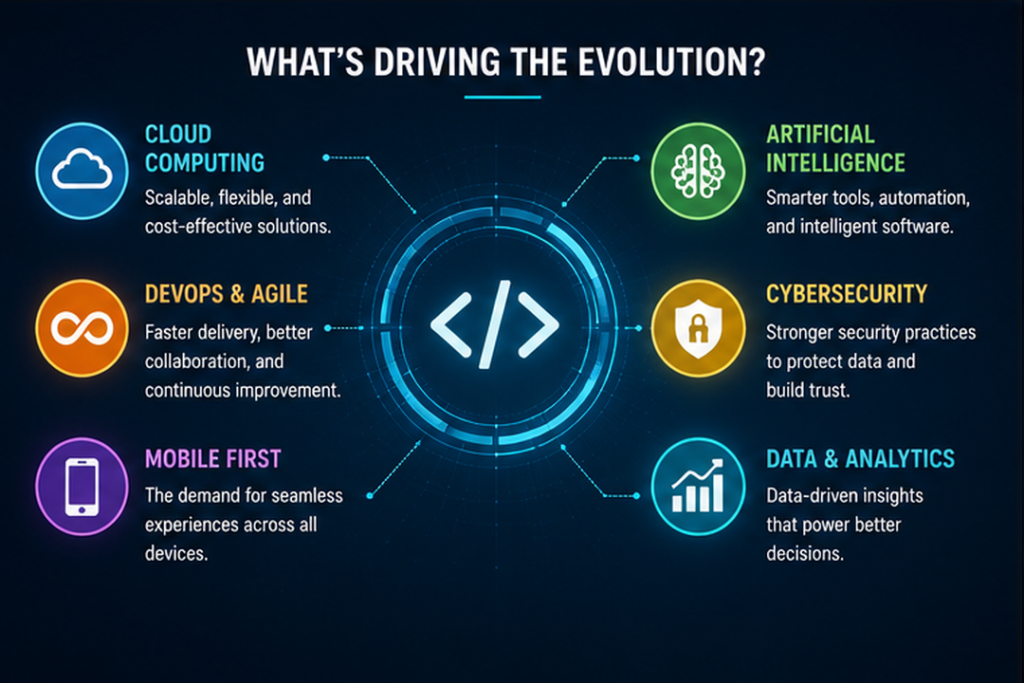
Modern development teams increasingly rely on collaboration platforms, cloud infrastructure, automation, reusable components, artificial intelligence, continuous testing, and rapid deployment practices.
The Early Days of Software Development
In the early years of computing, software development was highly specialized.
Computers were expensive, large, and available mainly to governments, research institutions, universities, and major corporations. Programmers often worked much closer to the hardware and had limited computing resources.
Development cycles could be long because software was often created for specific machines or organizational requirements.
As personal computers became more widely available, software development expanded rapidly. Developers started creating operating systems, productivity applications, games, databases, and business software for a much larger audience.
The growth of the internet then introduced another major transformation.
Software was no longer limited to individual computers. Applications could connect users around the world, exchange information instantly, and deliver services through web browsers.
This laid the foundation for today’s highly connected digital environment.
From Waterfall to Agile Development
One of the most important changes in software engineering has been the evolution of development methodologies.
Traditional projects often followed the Waterfall model. In this approach, teams generally moved through development stages in sequence. Requirements were defined first, followed by design, development, testing, and deployment.
This model can work well when project requirements are clear and unlikely to change. However, digital markets often change too quickly for rigid development cycles.
Agile development introduced a more flexible approach.
Instead of waiting months or years to deliver a complete product, Agile teams typically divide work into smaller development cycles. Features can be developed, tested, reviewed, and improved incrementally.
This allows teams to respond more effectively to user feedback and changing business requirements.
Agile methodologies have helped make software development more collaborative, adaptable, and customer-focused.
The Rise of DevOps
Agile changed how software was developed, while DevOps helped transform how software development and IT operations work together.
Historically, development teams could build applications and then hand them to separate operations teams responsible for deployment and infrastructure.
This separation sometimes created delays and communication problems.
DevOps encourages closer collaboration between development and operations teams. It also places strong emphasis on automation.
Modern DevOps practices may include continuous integration, continuous delivery, infrastructure automation, automated testing, monitoring, and rapid feedback.
The goal is to make software delivery more reliable and efficient.
Instead of treating deployment as a major event that happens only occasionally, organizations can release smaller updates more frequently.
This has become especially valuable for websites, cloud services, mobile applications, and digital platforms that need continuous improvement.
Cloud Computing Changed Software Development
The growth of cloud computing has had an enormous impact on modern software development.
In the past, companies often needed to purchase, install, and maintain physical servers before launching large digital applications.
Cloud platforms changed this model by providing computing resources through online infrastructure.
Developers can now access servers, databases, storage, networking, analytics, artificial intelligence services, and other technologies without necessarily managing every physical component themselves.
Platforms offered by companies such as Amazon Web Services, Microsoft Azure, and Google Cloud have helped make scalable infrastructure more accessible.
Cloud computing also supports flexible development environments. Teams located in different parts of the world can collaborate on the same applications and infrastructure.
For many organizations, cloud technology has shortened the path between an idea and a working digital product.
Mobile Development Transformed User Expectations
The widespread adoption of smartphones created another major shift in software development.
Users now expect digital services to work smoothly across mobile phones, tablets, laptops, and desktop computers.
This means developers must consider screen sizes, performance, battery usage, accessibility, connectivity, and user experience across multiple devices.
Mobile applications have also changed how businesses interact with customers.
Banking, shopping, food delivery, transportation, entertainment, communication, education, and healthcare services are increasingly available through mobile applications.
As a result, mobile-first and responsive development have become important parts of modern software strategies.
The evolution of mobile technology demonstrates an important lesson: software development must continuously adapt to changes in how people use technology.
Artificial Intelligence Is Reshaping Software Development
Artificial intelligence is becoming one of the most influential technologies in modern software engineering.
AI-powered development tools can assist programmers with tasks such as generating code suggestions, explaining existing code, identifying potential errors, creating documentation, and supporting testing.
This can improve productivity when the tools are used carefully.
However, AI-generated code still requires human review. Developers must evaluate whether generated solutions are accurate, secure, maintainable, and appropriate for the intended application.
Artificial intelligence is also changing the products developers create.
Modern applications increasingly include AI-powered search, recommendation systems, chat interfaces, predictive analytics, image processing, language technologies, and intelligent automation.
This means developers are not only using AI to build software—they are also integrating AI directly into software experiences.
Low-Code and No-Code Development
Another important trend is the growth of low-code and no-code platforms.
Traditional software development usually requires programming knowledge. Low-code tools reduce the amount of manual coding required, while no-code platforms allow users to create certain applications through visual interfaces and prebuilt components.
These technologies can help businesses develop simple internal tools, workflows, websites, dashboards, and prototypes more quickly.
They can also enable professionals outside traditional software engineering roles to participate in digital development.
However, low-code and no-code platforms do not eliminate the need for professional developers.
Complex applications still require expertise in architecture, security, performance, integrations, data management, and scalability.
Instead, these platforms are expanding the range of people who can contribute to software creation.
Open-Source Software Accelerated Innovation
Modern software development would look very different without open-source technology.
Open-source projects allow developers to examine, use, modify, and contribute to software according to the applicable license.
Popular programming languages, frameworks, databases, development tools, operating systems, and infrastructure technologies often have strong open-source communities.
GitHub and similar development platforms have also made global software collaboration much easier.
A developer in one country can contribute to a project used by people around the world.
Open-source software reduces the need to build every component from the beginning and can accelerate experimentation and innovation.
At the same time, organizations need responsible processes for managing open-source dependencies, licensing, updates, and security vulnerabilities.
The Growing Importance of Cybersecurity
As software becomes more deeply connected with everyday life, security has become a fundamental development requirement.
Modern applications may handle personal information, financial data, business documents, authentication credentials, and other sensitive information.
A security weakness can therefore create serious consequences.
This has encouraged the growth of approaches such as DevSecOps, where security practices are integrated throughout software development rather than being considered only at the end.
Developers may use secure coding standards, automated vulnerability scanning, dependency monitoring, access controls, code reviews, and security testing.
The principle of security by design is becoming increasingly important.
Software should ideally be designed with security in mind from the beginning instead of attempting to fix every problem after deployment.
Automation Is Making Development Faster
Automation has become another defining characteristic of modern software development.
Many repetitive tasks can now be partially or fully automated.
Automated testing can verify whether application features behave as expected. Continuous integration systems can automatically build and test new code changes. Deployment pipelines can help move approved updates into production environments.
Automation can reduce manual effort and improve consistency.
However, automation should not be confused with removing human responsibility.
Developers still need to decide what should be automated, review results, investigate failures, and ensure that automated processes remain reliable.
The most effective development environments combine automation with skilled human decision-making.
Microservices and Modern Software Architecture
Traditional applications were often built as large monolithic systems in which many features were closely connected.
Modern development increasingly uses modular architectures.
Microservices architecture, for example, divides certain applications into smaller services that can be developed, deployed, and scaled more independently.
This approach can provide flexibility for large and complex platforms.
If one service experiences heavy demand, organizations may be able to scale that component without scaling the entire application.
However, microservices also introduce additional complexity involving networking, monitoring, security, data consistency, and service management.
Therefore, they are not automatically the best choice for every project.
The broader trend is toward designing software architectures that can evolve as requirements change.
User Experience Has Become a Development Priority
Successful software is not judged only by its technical capabilities.
Users expect applications to be simple, responsive, accessible, and intuitive.
This has made user experience (UX) an increasingly important part of software development.
Developers now work more closely with designers, researchers, product managers, marketers, and customers.
User feedback can influence interface design, navigation, performance improvements, and feature priorities.
Accessibility is also becoming more important.
Digital products should be designed so that people with different abilities can use them effectively.
The shift toward user-centered development shows that modern software engineering is not just about making technology work. It is also about making technology useful.
Remote Work and Global Development Teams
Software development has become increasingly global.
Cloud platforms, video conferencing, version-control systems, project-management applications, and collaboration tools allow developers to work together from different locations.
Organizations can build teams that include engineers, designers, testers, security specialists, and product professionals across multiple countries.
Remote collaboration provides access to a larger talent pool but also introduces challenges.
Teams need clear documentation, communication standards, effective project management, and secure access to development resources.
The ability to collaborate digitally is now an important professional skill alongside technical programming knowledge.
Data Is Driving Modern Software Decisions
Data has become central to how software products are developed and improved.
Developers and product teams can analyze how users interact with applications, which features are popular, where errors occur, and where users abandon a process.
This information can guide future improvements.
For example, analytics may reveal that users regularly leave an application during a complicated registration process. Developers can investigate the problem and simplify the experience.
Data-driven development allows organizations to make product decisions based on measurable behavior rather than assumptions alone.
However, collecting user data also creates privacy responsibilities. Organizations should collect information responsibly, protect it appropriately, and comply with applicable privacy requirements.
Challenges in Modern Software Development
Despite technological progress, modern software development faces several challenges.
The speed of technological change means developers need to continuously update their skills. Programming languages, frameworks, cloud platforms, security threats, and AI technologies can evolve rapidly.
Cybersecurity is another ongoing concern.
Software supply chains can include many external libraries and services, meaning vulnerabilities may appear in components that developers did not create themselves.
Technical debt can also become a problem when teams prioritize speed without maintaining code quality.
Other challenges include managing complex infrastructure, protecting user privacy, controlling cloud costs, maintaining compatibility, and avoiding unnecessary technological complexity.
Successful development therefore requires balancing innovation with stability and long-term maintainability.
Essential Skills for Future Software Developers
The role of a software developer is becoming broader.
Programming remains essential, but future developers can benefit from understanding several additional areas.
Knowledge of cloud computing, cybersecurity, databases, APIs, version control, automated testing, and AI-assisted development is increasingly valuable.
Soft skills are equally important.
Developers often work in multidisciplinary teams, which means communication, problem-solving, adaptability, documentation, and collaboration can significantly affect project success.
Perhaps the most important skill is the ability to keep learning.
A programming framework that is popular today may be replaced or transformed in the future. Developers who understand fundamental concepts and can adapt to new technologies will be better prepared for long-term careers.
The Future of Software Development
The future of software development will likely involve deeper integration between human developers and intelligent tools.
AI may automate more repetitive development tasks, while engineers focus on architecture, problem-solving, security, user requirements, and complex decision-making.
Cloud-native applications are also likely to continue growing, while edge computing may bring more processing closer to devices and users.
Software will increasingly interact with smart devices, robotics, augmented reality, connected vehicles, and other emerging technologies.
Development processes may also become more automated, allowing teams to test and release updates more efficiently.
However, faster development must be accompanied by stronger security, responsible AI practices, privacy protection, and quality assurance.
The future will not simply belong to organizations that produce software fastest. It will favor those that can create useful, secure, reliable, and adaptable digital products.
Conclusion
The evolution of software development in a fast-changing digital world reflects the broader transformation of technology itself.
Software development has progressed from rigid, hardware-focused processes to flexible, cloud-connected, automated, and increasingly AI-assisted environments. Agile development, DevOps, cloud computing, open-source software, mobile applications, cybersecurity, automation, and artificial intelligence have all contributed to this transformation.
Yet the fundamental goal of software development remains unchanged: solving real problems through technology.
As digital transformation continues, developers and organizations will need to remain adaptable. Learning new tools will be important, but understanding security, user needs, software quality, responsible data use, and fundamental engineering principles will be even more valuable.
Software development is no longer simply about writing code. It is about designing the digital systems that increasingly shape how people communicate, work, learn, shop, and interact with the world.