Technology is becoming smarter every year. Computers are no longer limited to following simple instructions or performing calculations. Modern systems can analyze information, understand patterns, process language, recognize images, and support people in making better decisions. One technology helping make this possible is Cognitive Computing.
Cognitive Computing combines artificial intelligence, machine learning, natural language processing, data analytics, and other technologies to create systems that can work with information in a way that is more similar to human thinking. These systems are designed to learn from data, understand context, and provide useful insights rather than simply producing results from fixed instructions.
In this article, we will explore what Cognitive Computing means, how it works, its major benefits, real-world applications, challenges, and its potential future.
What Is Cognitive Computing?
Cognitive Computing refers to computer systems designed to simulate certain aspects of human intelligence. These systems can process large amounts of structured and unstructured data, identify relationships, understand language, recognize patterns, and support decision-making.
Traditional computer programs usually depend on predefined rules. If a programmer gives a system specific instructions, the system follows those instructions to produce an expected result.
Cognitive Computing takes a more flexible approach. Instead of depending entirely on fixed rules, cognitive systems can use data and learning techniques to identify patterns and improve their responses over time.
For example, a traditional software program may search a database for an exact word. A cognitive system may analyze the meaning and context of a question before determining what information is most relevant.
This makes Cognitive Computing particularly useful in environments where information is complex, constantly changing, or difficult to organize.
How Does Cognitive Computing Work?
Cognitive Computing uses several technologies together. The exact architecture can vary depending on the application, but many cognitive systems rely on artificial intelligence and data-processing techniques.
Machine Learning
Machine learning allows systems to identify patterns in data and improve their performance based on previous information.
For example, a business can use machine learning to analyze customer behavior and identify which products customers may be interested in.
Natural Language Processing
Natural language processing, often called NLP, helps computers understand and process human language.
This technology is used in virtual assistants, customer-support systems, search tools, translation applications, and conversational software.
Data Analytics
Cognitive systems need data to identify patterns and generate insights. Data analytics allows these systems to examine large datasets and discover useful relationships.
Computer Vision
Computer vision allows computers to analyze images and video. It can be used for object recognition, document analysis, quality control, security applications, and medical imaging.
Pattern Recognition
Recognizing patterns is another important capability. Cognitive systems can examine large amounts of information and identify relationships that may be difficult for humans to notice manually.
Cognitive Computing vs Traditional Computing
One of the easiest ways to understand Cognitive Computing is to compare it with traditional computing.
Traditional computing generally works with clearly defined instructions. When a specific input is provided, the program follows its programmed logic to produce an output.
Cognitive systems are designed to handle more complex situations. They can process different types of information, learn from data, and consider context when generating results.
For example, traditional software may require a user to enter information into a specific format. A cognitive application may be able to understand a natural-language request and determine what the user is trying to accomplish.
However, Cognitive Computing does not mean that computers actually think exactly like humans. The technology uses algorithms and data to reproduce certain useful characteristics of human reasoning and interaction.
10 Powerful Applications of Cognitive Computing
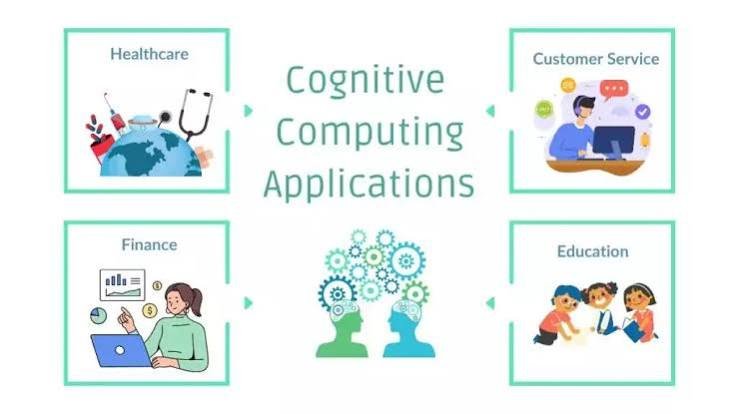
Cognitive Computing has applications across many industries. Here are some important examples.
1. Healthcare
Healthcare organizations generate huge amounts of information, including medical records, laboratory results, research papers, and imaging data.
Cognitive systems can help healthcare professionals analyze information and identify patterns. They may support medical research, patient management, and clinical decision-making.
These systems are intended to assist professionals rather than replace qualified medical judgment.
2. Financial Services
Banks and financial institutions can use Cognitive Computing to analyze transactions, identify unusual patterns, evaluate risks, and improve customer services.
For example, a cognitive system may examine transaction behavior and flag activity that appears unusual for further review.
3. Customer Support
Businesses can use cognitive technologies to create intelligent customer-support systems.
Instead of responding only to specific keywords, modern systems can analyze the meaning of customer questions and provide relevant answers.
This can help businesses handle common requests quickly while allowing human employees to focus on more complicated issues.
4. Retail
Retailers can analyze customer behavior, purchasing patterns, product searches, and feedback.
Cognitive technologies can help businesses understand customer preferences and provide more personalized experiences.
For example, an online store may analyze previous interactions to recommend products that are more relevant to a particular customer.
5. Manufacturing
Manufacturing companies can use cognitive systems to analyze equipment data and identify unusual behavior.
This can support predictive maintenance by helping organizations detect possible equipment problems before they result in unexpected downtime.
6. Education
Cognitive technologies can support personalized learning experiences.
Educational platforms may analyze a student’s performance and identify areas where additional practice could be helpful.
Teachers can also use data-driven insights to better understand learning patterns and provide targeted support.
7. Cybersecurity

Cybersecurity teams have to process large amounts of information from networks, applications, devices, and security systems.
Cognitive technologies can help analyze this information and identify suspicious patterns that may require investigation.
8. Transportation
Transportation companies can use intelligent systems to analyze traffic information, routes, demand patterns, and operational data.
These insights can help improve scheduling, route planning, and resource management.
9. Human Resources
Organizations can use cognitive technologies to analyze large amounts of workforce information.
They can assist with tasks such as searching documents, answering employee questions, and organizing information.
Human oversight remains important when systems are used for decisions that can significantly affect employees.
10. Scientific Research
Researchers often work with enormous datasets. Cognitive technologies can help organize information, identify relationships, and accelerate certain stages of research.
This can be especially useful in fields where researchers need to examine large amounts of scientific literature or experimental data.
Benefits of Cognitive Computing
Cognitive Computing can provide several important benefits when implemented responsibly.
Better Data Analysis
Organizations can use cognitive systems to analyze information much faster than manual processes in many situations.
Improved Decision Support
By identifying patterns and presenting relevant information, cognitive systems can help professionals make more informed decisions.
Increased Efficiency
Automation can reduce repetitive work and allow employees to spend more time on tasks that require creativity, communication, and human judgment.
Personalized Experiences
Businesses can use cognitive technologies to understand individual customer needs and provide more relevant services.
Continuous Learning
Many cognitive systems can improve their performance as they receive more high-quality data and feedback.
Challenges of Cognitive Computing
Despite its advantages, Cognitive Computing also comes with challenges.
Data Privacy
Cognitive systems may process sensitive information. Organizations need strong privacy policies and security controls to protect data.
Data Quality
Poor-quality data can produce poor results. Organizations should ensure that the information used by cognitive systems is accurate, relevant, and appropriately managed.
Bias
AI-based systems can sometimes reproduce biases present in their training data. Regular testing and human oversight are important for reducing this risk.
Implementation Costs
Building and maintaining advanced cognitive systems may require specialized employees, computing resources, software, and ongoing maintenance.
Lack of Explainability
Some complex AI systems can be difficult to understand. Organizations may need explainable and transparent systems, especially when decisions have significant consequences.
The Future of Cognitive Computing
The future of Cognitive Computing is closely connected with developments in artificial intelligence, machine learning, natural language processing, robotics, and data analytics.
As these technologies improve, cognitive systems may become better at understanding complex information and interacting naturally with people.
Businesses may increasingly use intelligent systems as decision-support tools rather than treating them simply as automation software.
However, technological progress will need to be accompanied by responsible data management, security, transparency, and human oversight.
The most successful applications will likely be those that combine the strengths of computers with the strengths of people. Computers can process enormous quantities of information quickly, while humans provide judgment, creativity, empathy, and ethical reasoning.
Final Thoughts
Cognitive Computing represents an important step in the development of intelligent technology. By combining machine learning, natural language processing, data analytics, computer vision, and pattern recognition, cognitive systems can help organizations work with complex information more effectively.
From healthcare and finance to retail, education, manufacturing, and cybersecurity, the technology has many potential applications.
At the same time, organizations should not view Cognitive Computing as a magic solution. Successful implementation requires reliable data, strong security, responsible development, skilled professionals, and appropriate human oversight.
As artificial intelligence continues to evolve, Cognitive Computing may become an increasingly important part of how people and organizations interact with information. The goal is not simply to create machines that appear intelligent, but to build useful systems that help people solve problems, discover insights, and make better-informed decisions.