




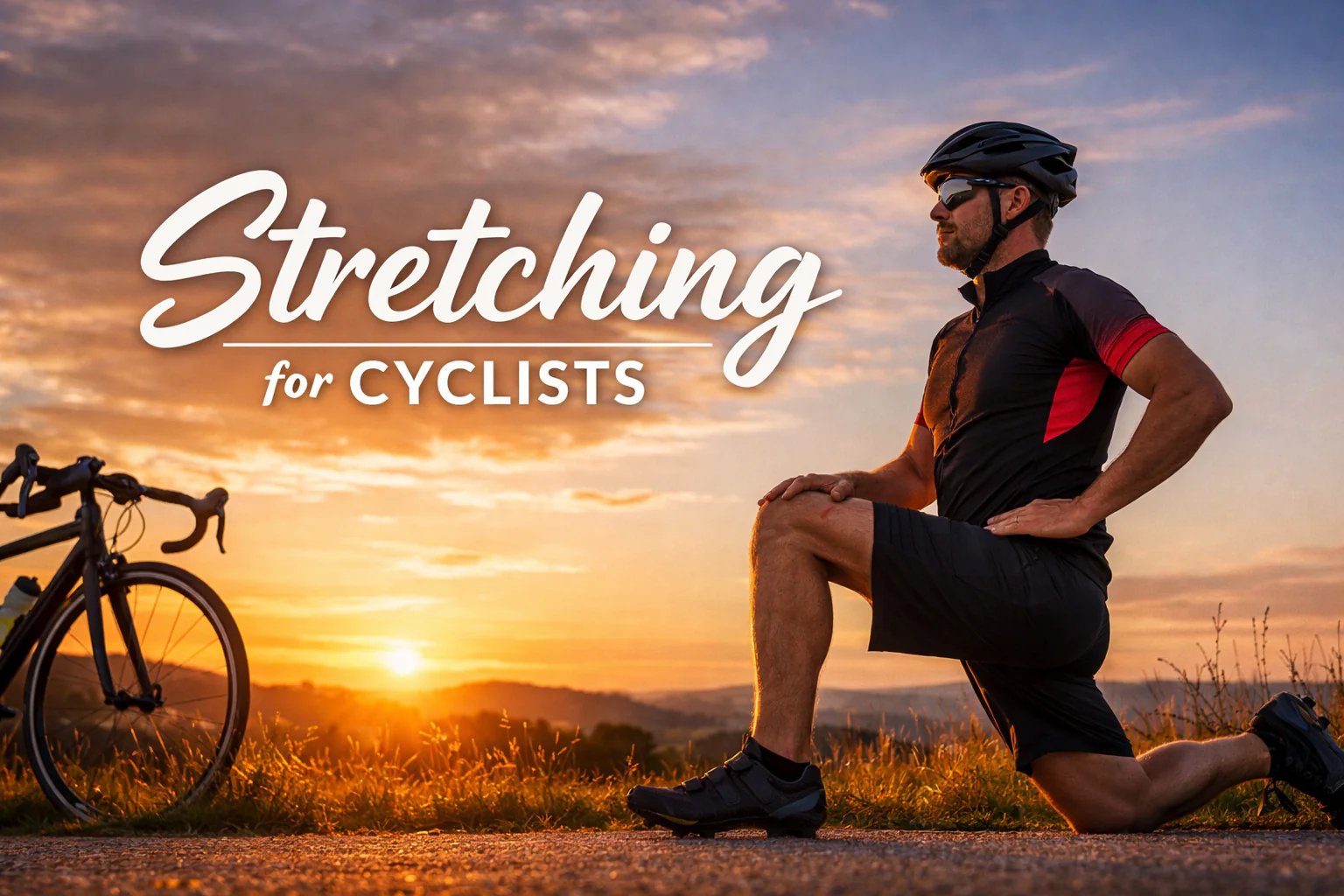
Cycling is simple in the best and worst way possible. You sit, you hinge forward, you turn the pedals—again and again, sometimes for hours. That repetition is what makes you stronger and more efficient… but it’s also why so many cyclists quietly accumulate tight hips, stiff hamstrings, locked-up calves, and that familiar neck-and-shoulder tension after longer rides.
Stretching won’t suddenly give you a new FTP or fix a bad bike fit. But when it’s done at the right moment and with the right intention, it can make riding feel smoother, recovery feel quicker, and your body feel less “compressed” day after day.
This isn’t a yoga class. It’s a realistic, cyclist-friendly way to think about stretching.
Why cyclists feel tight (even when they’re fit)
Cycling lives in a fairly narrow range of motion. Your hips stay flexed, your spine stays forward, and your ankles repeat the same movement thousands of times per ride. Add modern life—chairs, laptops, phones—and it’s no surprise certain areas start to complain.
Most cyclists notice tightness in a few predictable places:
-
Hip flexors, from endless hip flexion on and off the bike
-
Hamstrings, which work continuously through the pedal stroke
-
Glutes and deep hip muscles, especially after long seated efforts
-
Calves and ankles, from constant tension and climbing
-
Chest, shoulders, and upper back, from the forward riding posture
Stretching helps most when it’s used to restore balance, not chase extreme flexibility.
Timing matters more than the stretch itself
Before a ride: think “movement,” not “relaxation”
Right before riding, you’re not trying to get loose and floppy. You want joints moving freely and muscles ready to work. Long, passive stretches can actually make you feel sluggish if done immediately before harder efforts.
That’s why most performance-focused advice leans toward dynamic movement before riding—controlled swings, circles, and lunges that gently explore range of motion without switching your nervous system off.
Think of it as oiling the hinges, not pulling them apart.
After a ride: this is where stretching shines
After the ride—especially later in the day—is when classic stretching fits naturally. Your muscles are warm, breathing is calmer, and there’s no need to worry about power output.
Cycling-specific resources like Cycling UK and NHS exercise guidance consistently place stretching after activity, where it’s used to unwind tissues that have spent hours under steady load:
This is also when stretching simply feels better—and that matters if you want to stick with it.
A simple pre-ride warm-up (5 minutes, no mat)
You don’t need a full routine. Just enough movement to wake things up.
Hip circles (standing)
Hands on hips, slow circles in both directions. Stay tall and controlled.
Leg swings, front to back
Hold your bike or a wall. Swing from the hip, gradually increasing range.
Leg swings, side to side
Great for hips and adductors—keep it smooth, not forced.
Walking lunges with reach
Step into a lunge, lightly squeeze the glute on the back leg, and reach overhead.
Ankle rocks
In a split stance, gently drive the front knee forward while keeping the heel down.
Five minutes like this is usually enough to feel ready without feeling drained.
The post-ride stretch cyclists actually stick with (10–12 minutes)
This is where most of the benefit lives. Aim for 30–60 seconds per stretch, breathing slowly.
Half-kneeling hip flexor stretch
Kneel on one knee, other foot forward. Gently tuck the pelvis, squeeze the glute on the kneeling side, and ease forward.
This stretch appears in many NHS physiotherapy guides for people who sit or cycle a lot:
https://www.kentcht.nhs.uk/leaflet/stretching-exercises/
Quad stretch
Standing, grab the ankle behind you. Keep knees close together and hips neutral.
Hamstring stretch
Lying on your back with a towel or strap is joint-friendly and easy to control. NHS guidance often recommends this variation for post-exercise recovery.
Figure-4 glute stretch
Cross one ankle over the opposite knee and gently pull the leg in. A favourite among cyclists after long seated rides.
Calf stretch (straight and bent knee)
Straight knee for gastrocnemius, bent knee for soleus. Both matter.
Chest opener and upper-back reset
A doorway pec stretch followed by gentle upper-back extension over a chair or foam roller helps undo the riding posture.
How hard should stretching feel?
Here’s the simplest rule that actually works:
-
Aim for 3–6 out of 10 intensity
-
You should feel tension, not pain
-
No sharp pulling, numbness, or joint pinching
If a stretch only feels intense when you arch your lower back or twist, back off and clean up the position. Better form beats deeper range every time.
Stretching won’t fix everything (and that’s okay)
If the same spot keeps tightening up no matter how much you stretch, that’s usually a clue—not a failure.
Often the missing pieces are:
-
Bike fit (saddle height, reach, cleats)
-
Basic strength (especially glutes and core)
-
Recovery habits (sleep, fueling, easy days)
British Cycling’s performance education regularly frames stretching as one tool among many—not a standalone solution:
https://www.britishcycling.org.uk/knowledge/article/izn20130617-Phil-Burt-s-Big-Four-0
A realistic weekly approach
-
Easy rides: full post-ride stretch
-
Hard days: quick dynamic warm-up + short post-ride stretch
-
Rest days: light mobility and relaxed stretching
Ten minutes done often will always beat long sessions done rarely.
Stretching isn’t glamorous. It won’t show up on Strava. But it’s one of those quiet habits that makes cycling feel better over months and years—not just in your legs, but in how your whole body moves on and off the bike.
how-to-move-better-ride-stronger-and-recove-cool-dude-cycling